Imagination Station Books #8 and #9 Review and Giveaway

I’m happy to share with you today a review of the newest Imagination Station books presented by Focus on the Family and published by Tyndale. They tell the adventures of cousins Beth and Patrick as they travel back in time through the Imagination Station of Odyssey (for all you Adventures in Odyssey fans!). We were once again not disappointed by this series. I love that they are written for younger kids. My 9 and 10-year-olds especially enjoyed reading them to themselves. And I read them aloud to my non-readers.  (They are recommended for ages 7 and up, Flesch-Kincaid Grade Level: 2.1.)

Another thing we particularly liked was the introduction to two of history’s greatest Christian heroes: James Calvert and Corrie ten Boom.  Maybe I can muster enough courage now to read ten Boom’s The Hiding Place (holocaust stories are so emotional for me), and I’d love to read more about James Calvert!

AIO Imagination Station Book #8 | Battle for Cannibal Island by Marianne Hering and Wayne Thomas Batson

It’s 1852 and cousins Patrick and Beth sail to Fiji on the HMS Calliope under the command of Captain James E. Home. They arrive at the islands to find that the Christian Fijians are at war with the non-Christian Fijians. Missionary James Calvert is trying to make peace and suggests that the captain allow peace negotiations on board the British vessel. Patrick and Beth learn about sacrificial living when they observe Calvert’s determination to live on Fiji despite the dangers and impoverished conditions and that he is willing to risk his life to live as Jesus would.

AIO Imagination Station Books #9 | Escape to the Hiding Place by Marianne Hering and Marshal Younter

Patrick and Beth arrive in World War II Holland in the farm country. They must smuggle a baby (by bicycle) into the capable hands of Corrie ten Boom at her home in Haarlem. Along the way they hide from Nazi soliders, meet a Russian surgeon forced into service by the Germans, and see the famous “hiding place” at the ten Boom’s watch shop. The children learn to appreciate the bravery and sacrifice of everyday people who helped the Jews.

See the Imagination Station Website to learn more about the books!

To purchase these books:


To read my other Imagination Station reviews:

Blog Tour Day 1, Day 2, Day 3, Day 4, Day 5

To enter the giveaway of the two books:

One winner will win both books–announcement next week!  Winner will be notified by email and have 48 hours to respond back.

(Note:  The winner will not be chosen by leaving a comment.  You must enter through the Rafflecopter app below–choose any or all tasks to enter!  Click through to http://ichoosejoy.org if you’re reading this in email or a reader.)

a Rafflecopter giveaway

Linked to
Giveaway Day

(Thank you to the publishers at Tyndale for providing review copies for us.  All thoughts and opinions are my own.  Post contains affiliate links.)

How do we do Circle Time?

A number of years ago I read about Kendra Fletcher’s views on Circle Time.  I thought, “This is what I want!”  But for years, no matter how hard I tried I could never get all of us organized in the morning to meet together as a family.  So, I finally accepted that we would just do it in the afternoon as soon as I put the baby/toddler (s) down for a nap.  And that HAS worked for years!

This year, we have quite a few things that we accomplish during our Circle Time.  We usually meet together (ages 4-11) for one to one and a half  hours.  There’s so much on our list, we can’t do it all everyday, but here’s what we choose from:

Pray

Read Scripture (reading through Mark right now)

Read Bible storybook or discipleship

Scripture Memory practice (memorizing Col. 3:23-24)

Poetry reading (one poem/day)

Practice for our public speaking class (they memorize a speech, story, or poem to recite each week)

Science (Exploring Creation with Zoology 2, Swimming Creatures from Apologia)

Worldview (Who Am I? from Apologia)


History (The Mystery of History, volume 2)

Historical Fiction (right now we’re reading Twice Freed by Patricia St. John)

Narration practice on one or more of the read-alouds, from the same day or the day before


It’s one of my favorite times of the day!
Photobucket

Photobucket

Linked toFavorite Resource This Week

(Contains affiliate links)

Homeschool Curriculum 2012-2013

Here is our 2012-2013 Curriculum


Photobucket Pictures, Images and Photos

B (age 11, 6th grade):

Following “The Grammar Level:  Ten Things to Do From Ages 10-12″

Bible:  Discover 4 Yourself Inductive Bible Studies for Kids — Revelation (Bible Prophecy for Kids and A Sneak Peek into the Future)

Grammar:  Daily Grams 6 (Easy Grammar)

Latin:  First Form Latin

Music:  violin lessons, band (saxophone) at Christian school

History:  Mystery of History and Story of the World, vol. 2 (After Resurrection thru Middle Ages) with notebooking materials from Homeschool in the Woods (New Testament) and Lilliput Station; read-alouds of historical fiction

Pre-Logic:  Logic: Building Thinking skills, book 3 figurative

Math:  Epsilon math, then Zeta math from Math-U-See

Science:  Apologia science Zoology 2 (Swimming Creatures) with notebooking journals and experiment kit

Composition:  How to Write a Story by Evan-Moor, then Writing for 100 Days

Public Speaking:  Institute for Cultural Communicators Basic Public Speaking book
Worldview: Who am I? book and notebooking journal by Apologia
Geography Bee
Spotlight drama class (and possibly perform in a musical)
J (age 10, 5th grade):

Following “The Grammar Level:  Ten Things to Do From Ages 10-12″

Bible:   Discover 4 Yourself Inductive Bible Studies for Kids — Revelation (Bible Prophecy for Kids and A Sneak Peek into the Future)

Spelling & Grammar:   Better Spelling in 5 Minutes a Day and then Spelling Power;  Daily Grams 5 (Easy Grammar)

Latin:  First Form Latin

Music:  violin and piano lessons

Art:  ocean boxes

History:  Mystery of History volume 2 and Story of the World volume 2 (After Resurrection thru Middle Ages) with lapbooking materials from Homeschool in the Woods (New Testament) and Lilliput Station; read-alouds of historical fiction

Pre-Logic:  Logic: Building Thinking skills, book 2

Math:  Epsilon math from Math-U-See

Science:  Apologia science Zoology 2 (Swimming Creatures) with notebooking journals and experiment kit

Public Speaking:  Institute for Cultural Communicators Basic Public Speaking book for public speaking class

Worldview:  Who am I? book and notebooking journal by Apologia
Geography Bee
Spotlight drama class (and possibly perform in a musical)
M (age 8, 3rd grade):

 Reading and Handwriting, Narration:  read to self 30 minutes a day; finish reading Rod and Staff readers–Bible Nurture and Reader Series  (finish brown books and first gray book); copy work of Revelation

Arts and Crafts:  ocean boxes, sewing projects, Picture study of paintings

Music:  violin and piano lessons

Bible:   Discover 4 Yourself Inductive Bible Studies for Kids — Revelation (Bible Prophecy for Kids and A Sneak Peek into the Future)

Math:  Alpha and Beta, Math-U-See

Science:  Apologia science Zoology 2 (Swimming Creatures) with notebooking journals and experiment kit

History:  Mystery of History volume 2 and Story of the World volume 2 (After Resurrection thru Middle Ages) with lapbooking materials from Homeschool in the Woods (New Testament) and Lilliput Station; read-alouds of historical fiction

Public Speaking:  Institute for Cultural Communicators Basic Public Speaking book

Worldview:  Who am I? book and notebooking journal by Apologia
Pre-Logic:  Think a Minutes from Critical Thinking
Spotlight drama class (and possibly perform in a musical)


R (age 7, 2nd grade):

Reading and Handwriting, Narration:  phonics (TATRAS) and read aloud to Mom (McGuffey readers then Rod and Staff Bible Nurture and Reader Series, green books); Explode the Code (book 3 – ?);  finish printing Handwriting Without Tears books and then do various copywork.

Bible:  Mom reads aloud The Jesus Storybook Bible ( Lloyd-Jones)Roma Downey’s Little Angels Bible Storybook, and Leading Little Ones to God (Schooland)

Science:  Apologia science Zoology 2 (Swimming Creatures) with notebooking journals and experiment kit

Arts and Crafts:  ocean boxes, sewing projects, Picture study of paintings

Public Speaking:  Institute for Cultural Communicators Basic Public Speaking book

Worldview:  Who am I? book and notebooking journal by Apologia
History:  Mystery of History volume 2 and Story of the World volume 2 (After Resurrection thru Middle Ages) with lapbooking materials from Homeschool in the Woods (New Testament) and Lilliput Station; read-alouds of historical fiction
T (age 5, Kindergarten):

Reading and Handwriting, Narration:  phonics (TATRAS) and read aloud to Mom (McGuffey readers then Rod and Staff Bible Nurture and Reader Seriesgreen books); Explode the Code (book 2 – ?); Handwriting Without Tears books and then do various copywork if time

Bible:  Mom reads aloud The Jesus Storybook Bible ( Lloyd-Jones)Roma Downey’s Little Angels Bible Storybook, and Leading Little Ones to God (Schooland)

Science:  Apologia science Zoology 2 (Swimming Creatures) with notebooking journals and experiment kit

Arts and Crafts:  ocean boxes, painting, play-doh

Public Speaking:  Institute for Cultural Communicators Basic Public Speaking book

Worldview:  Who am I? book and notebooking journal by Apologia
History:  Mystery of History volume 2 and Story of the World volume 2 (After Resurrection thru Middle Ages) with lapbooking materials from Homeschool in the Woods (New Testament) and Lilliput Station; read-alouds of historical fiction
Music:  violin lessons
L (age 3, Preschool):

Reading and Handwriting, Narration:  phonics (TATRAS); Handwriting Without Tears books and do various copywork

Bible:  Mom reads aloud The Jesus Storybook Bible ( Lloyd-Jones)Roma Downey’s Little Angels Bible Storybook, and Leading Little Ones to God (Schooland)

Science:  Apologia science Zoology 2 (Swimming Creatures) with notebooking journals and experiment kit

Arts and Crafts:  ocean boxes, painting, play-doh

History:  Mystery of History volume 2 and Story of the World volume 2 (After Resurrection thru Middle Ages) with lapbooking materials from Homeschool in the Woods (New Testament) and Lilliput Station; read-alouds of historical fiction

Worldview:  Who am I? book and notebooking journal by Apologia
Linked to

Homeschool 2012/13: Historical Fiction for Middle Ages

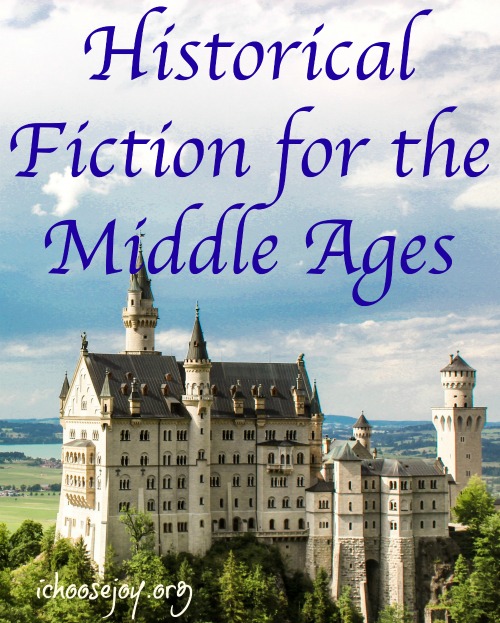
Along with our wonderful history curriculum, Mystery of History, we’ll be reading lot of historical fiction.  It’s such an exciting way to study history–and makes it more memorable, too!  We’re in volume 2, which covers Pentecost (A.D.  29) through the Gutenberg Press (1456).  This period of history always feels very boy-oriented to me:  evil Roman emperors, Vikings, Knights, Robin Hood, and Marco Polo!  It should be a fun year!

We’ll also be listening to Story of the World in the car (end of volume 1 through volume 2).

Photobucket

In the following list, the number before the book name is the corresponding chapter in Mystery of History.  (I’m sure we won’t have time to read all of these, but here’s what we’ll choose from.)

1-  John: Son of Thunder (Ellen Gunderson Traylor) own

1- Twice Freed (Patricia St. John) own

2- Adventures in Odyssey:   Bible Eyewitness Hall of Faith, New Testament stories — audiobook at library

9- Pompeii. . .  Buried Alive (Kunhardt) library; The Buried City of Pompeii (Tanaka) library; Eyewitness: Volcano (Dorlink Kindersly) DVD at library

22- Days of Knights and Damsels: An Activity Guide (Carlson) own

22- The Knight and the Dragon (Tomie DePaola) own

22- St. George and the Dragon (Hodges) own

22- The Barefoot Book of Knights (Matthews) own

22-The Door in the Wall (Margueite de Angeli) own

22- Castle (David MacCauley) library

22- Castle Diary: The Journal of Tobias Burgess, Page (Platt) library

22- The Story of King Arthur and His Knights (Pyle) own on Kindle

22- King Arthur and His Knights (Jim Weiss) audiobook at libary

23- A Connecticut Yankee in King Arthur’s Court (Mark Twain) audiobook at library

24- Camelot — DVD at library

25- Across a Dark and Wild Sea (Don Brown) library

32- Beowulf (children’s version) library

38- Arabian Nights (Jim Weiss) audiobook at library

37- Son of Charlemagne (Barbara Willard) own

39- Beorn the Proud (Pollard) own

40- The Story of Rolf and the Viking Bow (French) library

47- Grimm’s Fairy Tales — own on Kindle

52- Leif the Lucky (D’Aulaire) library

53- Macbeth: For Kids (Burdett) or in Lamb’s Book of Shakespeare — both at library

53- MacBeth- DVD of the play — library

53- Beautiful Stories from Shakespeare (Nesbitt) own on Kindle

55- Cathedral (David MacCauley) library

58- Paula the Waldensian (Lecomte, translated by W.M. Strong) own on Kindle

62- Robin Hood of Sherwood Forest (Ann McGovern) own

62- Robin Hood — movie versions

63- The Trumpeter of Krakow (Kelly) library

63- Men of Iron (Pyle) own on Kindle, audiobook at library

64- The Apple and the Arrow (Buff) library

66- Adam of the Road (Gray) own

71- Marco Polo for Kids (Herbert) library

71- Marco Polo (Kent) own

72- In Freedom’s Cause:  A Story of Wallace and Bruce (Henty) audiobook at library

78- The Beggar’s Bible (Vernon) own

78- Morning Star of the Reformation (Thomson) own

79- Chanticleer and the Fox (adapted by Barbara Cooney) library

81- Joan of Arc (Morpurgo) own


(contains affiliate links)

Imagination Station- My kids’ review

I’ve had a really fun week doing this blog tour!  I hope you’ve enjoyed it, too.  I thought I’d leave you with a few reviews from my kids!

My 9-year-old said he liked book # 5 (Showdown With the Shepherd) about David and Goliath the best of all six.  He liked how Hugh tried to change history but couldn’t.  This boy has had a harder time getting into reading on his own.  I feel the Imagination Station books gave him a boost because he felt successful reading them, and they didn’t take him too long (about three days to read each book).

Photobucket

My 7-year-old also really enjoyed the books.  She had previously been reading picture books, but the Imagination Station books pushed her into the wide world of chapter books!  It was so fun to see her bringing the books with her in the car and then back inside to read on the couch and in bed at night!  She said she enjoyed book # 6 the best (Problems in Plymouth) about Patrick and Beth’s interactions with the Pilgrims and witnessing the first Thanksgiving.

Photobucket

My 10-year-old said the books had a pretty good plot but were a little too short and easy for his age.  (He was reading Lord of the Rings at age 6!)  His favorite was book # 3 (Peril in the Palace) about the Mongols and Marco Polo.  He was able to read each book in an afternoon.

I will certainly be getting the next books in the series as they come out.  They aren’t fun as read-alouds (I prefer a higher reading level for that!), but are wonderful for the kids to read on their own.

Today is the last day to leave a comment to be entered into the drawing to win a set of all six books.  I’ll announce the winner on Monday!


If you’d like to order the books, please use my referral link to Barnes and Noble.  Thanks!
Barnes&Noble.com

Imagination Station- What the future holds

I hope you’ve enjoyed the Q and A with Marianne Hering, main series author of the Imagination Station book series.  Here are a few more insights from her, and she tells us about the next books which will come out.

Be sure to leave a comment again today to be entered into the drawing for all 6 Imagination Station books!

Imagination Station Blog Tour

Q&A with Marianne Hering

9. What do you hope kids will walk away with after reading Imagination Station?

A smile and a desire to learn more about history and faith in Jesus Christ.

10. Can you give us any “sneak peeks” into what we can expect in future books?
Here’s the not-so-sneak peek. Book 7 is advertised in book 6, and I already have material about it on TheImaginationStation.com. Book 7 is set in ancient Egypt and involves a mummy and a scary tomb. Book 7 is at the printer right now. It’s my favorite cover so far.

Photobucket

Book 8 is exciting because we have a new author joining our team. We’re writing this one with best-selling Christian author Wayne Thomas Batson. We wanted to tell a pirate story, and since he’s an expert and had already written some fabulous pirate stories, we asked him to help us. Book 8’s title is Mystery of Starlight Island. Look for Wayne Thomas Batson’s “Focus on the Family approved” pirate books, The Isle of Swords and The Isle of Fire (for upper elementary and tween readers). Go to FocusontheFamily.com/resources and type Wayne Batson in the search box.

Photobucket

Book 9 sneak-peek. We’re going to the most modern setting yet. The kids will be visiting a famous person who lived during WWII.

If you’d like to order the books, please use my referral link to Barnes and Noble.  Thanks!
Barnes&Noble.com

Imagination Station- More Q and A with Marianne Hering

Be sure to leave a comment today to be entered in the giveaway for a drawing of the first 6 books of the series!  You can leave a comment each day this week, for a total of 5 entries.

Photobucket                    Photobucket

Photobucket

Imagination Station Blog Tour

Q&A with Marianne Hering

5. These books are geared towards young readers, ages 7 and up. What is the number one issue that children learning to read struggle with?

Speed processing. The kids who are slower reading learners usually need more help with sight words and fluency. That’s just practice at an accessible reading level. These are just slower readers in general—I’m not counting kids with true auditory processing issues or other learning disabilities, which represent between 3 and 10 percent. Most kids can learn to read better with one-on-one instruction and a loving atmosphere. I’ve posted reading tips on the website for each book and lists of words to practice before tackling a chapter. SeeTheImaginationStation.com.

6. What kinds of books do you recommend children read?

I don’t only recommend books. There are fabulous magazines out there for this age group. Not all kids like fiction, so magazines draw them in with nonfiction and pictures. There are some good book series out there—I personally give my children the tried-and-true series written years ago, like Beverly Cleary’s Ramona books. My boys enjoyed the Horrible Harry books by Suzy Kline. My daughter was a Gertrude Chandler Warner/Boxcar Children fanatic. Parents can ask librarians to recommend books. One of my sons loves anything about animals in the nonfiction section—I don’t make him read fiction unless it’s for school. I do have to review their books first, and that can take a lot of time, but it’s worth it.

7. What are some ways that parents can help their children develop their reading skills?

(Get their vision checked for not only vision but for tracking issues as well.) Turn off the electronics and make reading a fun time. You can read to them or they can read to you. Make reading an event. Your kids will complain for about two weeks while the electronic addiction wears off. Then they will be better able to engage in literary pursuits. For free reading, let your kids read “easy” books. Don’t judge. If they want to read Hop on Pop twenty times, that means that’s where they are comfortable. If you push your kids beyond what they perceive to be the right level, they will rebel. Better a lot of fluent reading at an easy level than choppy reading at a higher level. Reading with starts and stops is a bad habit to let them get into.

8. What encouragement can you offer parents who may have reluctant or struggling readers?

I can encourage parents by letting them know that there are GREAT reading programs for kids. Most kids, 60 percent, need extra help at home to make it to the fourth grade reading level. That extra help can come from parents who gently and lovingly make reading a family hobby. There is no lack of teaching material, and your school districts should be able to help you find the right tools. The biggest factor in children’s success at school is a loving parent who takes the time to work with their children. One of my sons could not learn to sound out letters quickly enough to “hear” the word. I couldn’t help him, and so I hired a reading specialist who was more of a cognitive trainer and we worked through his auditory glitch. There are some terms to search “phonemic” awareness and “phonograms” that will help parents read more about how to help emergent readers. When the kids know how to sound out words, speed training on sight words can jump start their reading fluency. On the website, TheImaginationStation.com, I’ve prepared this long essay on how use a metronome to speed up your child’s reaction time to sight words. It’s under the book The Attack at the Arena. Don’t give up. Virtually every kid can learn to read well enough to go to college if his or her parent(s) invest in them.


Join us tomorrow as we find out what the future holds for the Imagnination Station book series!

If you’d like to order the books, please use my referral link to Barnes and Noble.  Thanks!
Barnes&Noble.com

Imagination Station–Meet the Authors, Q and A

Yesterday, I shared about a wonderful new series called Imagination Station which is historical fiction written for early readers (ages 7 and up).  If you’d like to receive a copy of all six Imagination Station books, join our giveaway!  Just leave a comment each day this week (total of 5 entries available per person).  The winner will be randomly chosen next Monday, November 14.

Today, I’d love to introduce you to the authors:


Paul McCusker (creative director) has written more than 300 episodes of Adventures in Odyssey, as well as 18 novels and two screenplays

Photobucket

Marianne Hering (main series writer) has written hundreds of articles and a number of books for children and parents.

Photobucket

Brock Eastman (series writer) started writing The Quest for Truth series in 2005 and has written more than nine books since.

Photobucket

Marshall Younger (series writer) has written over 100 Adventures in Odyssey episodes and four novels.

Photobucket

Q and A with Marianne Hering

Imagination Station Blog Tour

Q&A with Marianne Hering

1. What inspired you to write the Imagination Station series?

Paul (McCusker) had always wanted to write stories about the Imagination Station. When looking to do a kids’ series about it, we chose early elementary to introduce new readers to the Adventures in Odyssey world. We also wanted to touch on a group of kids that didn’t have many Christian books written for their level. There seemed to be a gap from picture books to later elementary readers.

2. The Imagination Station device is well-known to fans of the radio drama Adventures in Odyssey. Why did you and Paul decide to use it in a book series?

It lends itself to stand-alone adventures. It’s a fascinating device. Why wouldn’t he want to write about it? It allowed us to write about settings outside of Odyssey. We’d like some of the books to augment the history kids learn from public school textbooks or TV. The Imagination Station radio dramas are also among the most popular. We thought that kids would like them, that’s all!

3. The first two books focus on the Vikings and ancient Rome. The next two books focus on Kubla Khan and the War of the Roses and now books five and six take readers to the Holy Land and back to Plymouth Rock. How did you and Paul decide which historical events to write about?

Paul and I aren’t the only ones who weigh into the decision. Paul and I have a creative team that also includes Adventures in Odyssey writer Nathan Hoobler, book publishing director Larry Weeden, and marketing manager Brock Eastman. I’m fortunate to have such a well-rounded and experienced bunch helping decide on setting, cover scene, and title. All that said, I do most of the research or verify the other writers’ research for the book’s outline. I’ve written a lot of historical fiction and had many of the ideas for settings and conversations in my mind and heart for years. I try to choose moments in history that reveal a hero’s Christian character and are historically accurate. The exception is book 4, Revenge of the Red Knight, which covered the War of the Roses. Because that war was so convoluted and political, it was difficult to find a well-defined real-life hero we could hold up as a role model. The hero, Sir Andrew, in that book is 100 percent fiction. The other books all have a true-life hero as a role model.

4. How true to history are Showdown with the Shepherd and Problems at Plymouth?

Let me start by informing readers that it’s my intent to answer all of these questions on TheImaginationStation.com website. The historical information is already posted in the parents section for books 1 and 2, and book 7’s material will be posted momentarily. I’m working on filling in the “what’s true and what’s not true” material for books 3, 4, 5, and 6. Hopefully in the next week.

Showdown with the Shepherd expands on the David and Goliath story. For readers who are not familiar with the story, we kept it as biblical as possible while adding three time travelers and a catapult. The Philistines are still gruesome and fearful and want to take the Israelites as slaves. Young shepherd boy David is mocked by his brothers. King Saul is still afraid to fight Goliath himself. David still whomps Goliath with God’s help. (I did get Goliath’s helmet wrong on the cover. The Philistine helmets had a funky topper.–I missed this because I was on vacation when the cover roughs came through and I didn’t check everything as carefully as I should have. Sorry for that. I work hard to get the details of the art to be accurate and feel bad when I overlook an important detail.) The setting was as accurate as I could make it. I did ask my boss to pay for me to fly to the Valley of Elah for “research,” but he wisely thought that would be a waste of ministry resources. :-)

Problems in Plymouth—the events all happened, just over a longer period of time than it did in the book. In reality, these events happened over about a year period. In the book it’s two days. John Billington and his family are real. John did get lost. Mr. Billington didn’t agree with William Bradford on what to do about Indian relations. Chiefs Aspinet and Yellow Feather are real. The Pilgrims did accidentally shoot some innocent Indians. The doctor is real. The issue of the stolen corn is real. The Pilgrims did fear that Squanto was kidnapped, and they set out to rescue him. The Pilgrims did bury their gun powder. The storage room did exist. The meeting house was described accurately as were the cannons. There were several types of muskets models used by the Pilgrims. The details of the first Thanksgiving were basically accurate. We depicted the traditional bell-shaped blunderbuss. However, many Pilgrims probably had muskets without the bell-shaped musket. Marshal Younger and I took some small liberties with the history (besides, of course, Hugh and the cousins). For example I’m not sure who was actually on the shallop that came to rescue John Billington. The dialogue between Bradford and Standish was based on research, but the actual words were fictionalized. We did try to quote Bradford in some places, but his language was so outdated we had to modify it a lot.


Tomorrow we’ll hear what Marianne has to say about writing for young readers and how to help them read better!


If you’d like to order the books, please use my referral link to Barnes and Noble!

Barnes&Noble.com

Imagination Station blog tour book review and giveaway

Photobucket                    Photobucket

I am excited to introduce you to a great new book series called the Imagination Station series.  Do you recognize “Imagination Station?”  Yes, it’s the time machine from Adventures in Odyssey!  These books are historical fiction using the tool of the Imagination Station to send Patrick and Beth, cousins, to different past historical time periods.  It’s described as a Christian version of Magic Tree House.  We were given a set of the books and enjoyed reading books 5 and 6 together as a family.  My three oldest kids read the first four books on their own as well.

We will be having our first Giveaway here at I Choose Joy!  I have a set of all six books to give to someone with a U.S. or Canadian address!  All you have to do is leave a comment.  I’ll be blogging about the books Monday through Friday this week, so you can leave a comment each day–a total of five entries!  The winner will be chosen randomly and announced next Monday, November 14.

Below is my review of the books.  Join me tomorrow as I’ll be sharing more about the authors and a special Q and A with one of them!

I love to use historical fiction in our history studies.  We read a history text as well, but stories are so much more memorable and really help the kids understand the times better.  So, I was very excited to find the Imagination Station book series!  They are written by some of the same authors who write the Adventure in Odyssey radio dramas, and are from a Christian perspective.  One unique thing about these books is the age range they are written for: ages 7 and up/ early readers.  I rarely find books that my younger readers can read by themselves.  These were perfect for my 7 and 9 year olds!  The stories are exciting, the words easy to read, and the chapters short.  And, yet, they are reading a “chapter book” by themselves!  I’m looking forward to more of these books so we can explore many more time periods and people of history!  See the website theimaginationstation.com to find lots more information such as family activites, devotional, parents page, vocabulary lists, etc.

If you’d like to purchase the books, here’s a referral link to Barnes and Noble:

Barnes&Noble.com